Introduction: What Are Duplicate Leads and Why Do They Matter?
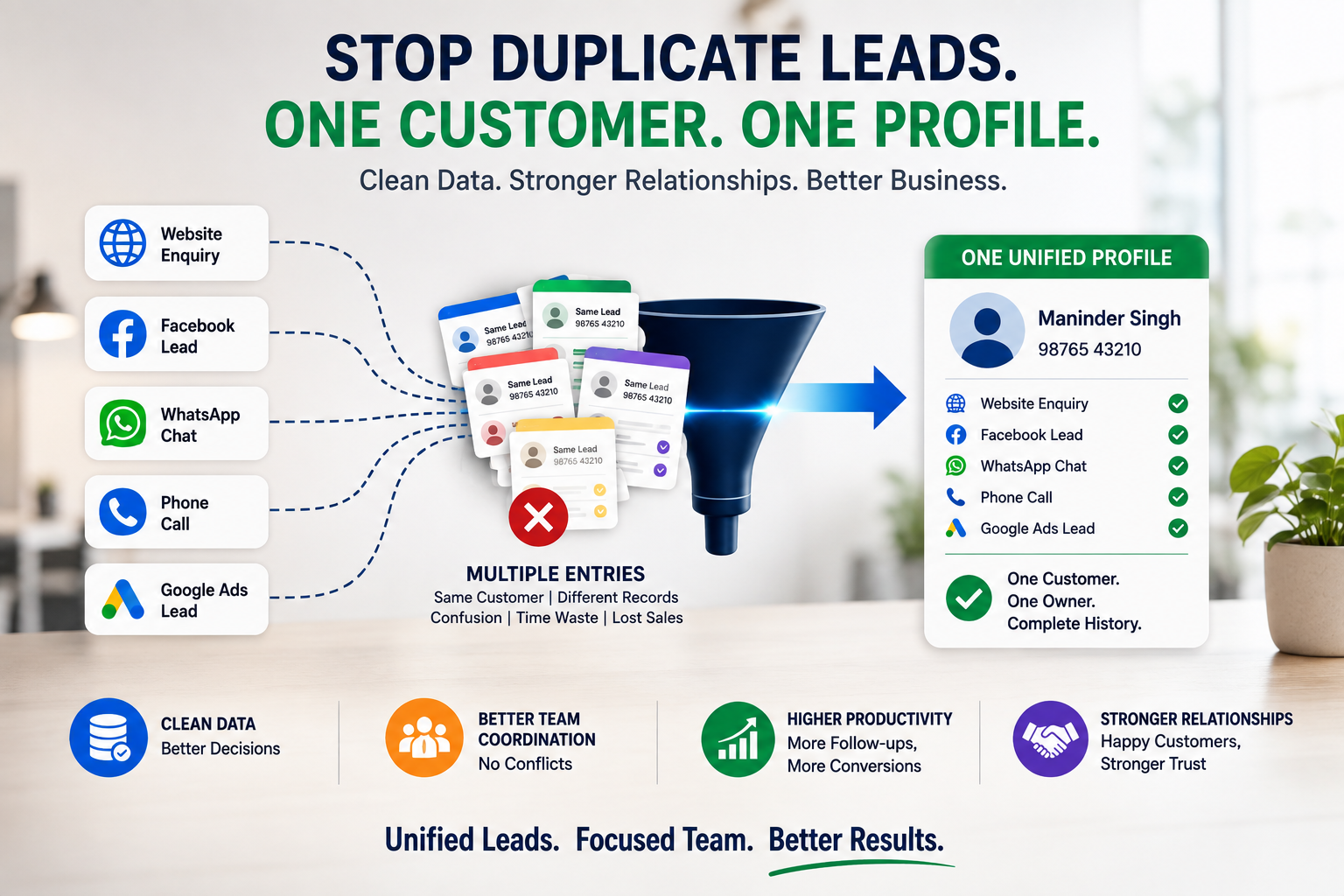
Duplicate leads are multiple records created for the same person or business. They usually appear when customers contact your company through different channels.
For example, a prospect may first submit a website form. Later, they may contact you through WhatsApp, Facebook, or a phone call.
Without proper lead management software, each interaction can become a separate lead.
This creates confusion for your sales team and can damage the customer experience.
What Is a Duplicate Lead?
A duplicate lead is the same customer recorded more than once in your business system.
For example:
- One enquiry comes from your website.
- The same person contacts your WhatsApp number.
- They later call your sales team.
- Another employee manually creates the same lead.
You may now have four records for one customer.
The customer has not changed.
Only your database has become duplicated.
This is why lead deduplication is important.
What Is Lead Deduplication?
Lead deduplication is the process of identifying duplicate customer records and keeping one accurate customer profile.
A good system can compare information such as:
- Mobile number
- Email address
- Customer name
- Company name
- Previous enquiry
- Communication history
- Lead source
The goal is simple:
One customer should have one reliable customer profile.
Why Do Duplicate Leads Happen?
Duplicate leads usually appear when businesses receive enquiries from multiple channels.
Common lead sources include:
- Website forms
- Google Ads
- Facebook Ads
- Phone calls
- Cloud telephony
- Walk-in enquiries
- Referral campaigns
- Landing pages
- Social media campaigns
- Online directories
- Manual data entry
- Excel files
- Imported customer databases
When these sources are not connected, the same customer can enter your system several times.
This problem becomes bigger as your business grows.
How Duplicate Leads Can Hurt Your Business
Duplicate data may look like a small administrative problem.
In reality, it can affect sales, customer service, reporting and team productivity.
1. Different Employees May Contact the Same Customer
Imagine a student contacts an immigration consultancy through Facebook.
The lead goes to one counsellor.
The student later fills out a website form.
Another counsellor receives the same enquiry.
Then the student calls the office.
A third employee may contact them.
Now three employees believe they own the same opportunity.
This creates the classic:
“This is my lead.”
“No, this is my lead.”
The customer sees internal confusion.
2. Customers May Receive Different Information
This is one of the biggest risks.
One employee may explain one process.
Another employee may provide different information.
A third employee may promise something else.
For the customer, this creates doubt.
They may start thinking:
“Does this company actually know what it is doing?”
Your brand reputation can suffer even when your actual service is good.
3. Sales Follow-Ups Can Become Confusing
A sales team needs to know:
- Who contacted the customer?
- When was the last conversation?
- What was discussed?
- What price was shared?
- What product was recommended?
- What objection did the customer raise?
- What should happen next?
Duplicate records hide this information.
The salesperson may repeat questions the customer has already answered.
That creates a poor customer experience.
How Duplicate Leads Affect CRM Data Quality
CRM data quality means keeping customer information accurate, complete, consistent and usable.
Duplicate records reduce data quality.
For example, your dashboard may show:
1,000 leads
But 150 records may belong to existing customers.
Your management team may think the business generated 1,000 unique opportunities.
The actual number could be much lower.
This affects important metrics such as:
- Lead generation
- Lead conversion rate
- Cost per lead
- Customer acquisition cost
- Sales pipeline
- Sales forecasting
- Marketing ROI
- Campaign performance
- Employee productivity
Clean customer data is therefore not just an IT issue.
It is a business decision-making issue.
How to Prevent Duplicate Leads in CRM
The best solution is to prevent duplicates before they spread through your database.
A modern CRM lead management system can help businesses create a centralized process.
Here are five practical approaches.
1. Use Phone and Email Matching
Your system can check existing records before creating a new lead.
For example:
New enquiry:
98765XXXXX
Existing record:
98765XXXXX
The system can identify a possible duplicate.
Instead of creating another customer profile, the new enquiry can be attached to the existing record.
This creates cleaner customer data management.
2. Keep One Customer Profile
Every interaction should ideally stay connected to one customer profile.
That profile can contain:
- Lead source
- Contact details
- Calls
- WhatsApp conversations
- Emails
- Follow-ups
- Notes
- Sales activities
- Previous enquiries
- Assigned employee
- Opportunity stage
- Customer support history
Your team gets one complete view.
This is often called a 360-degree customer view.
In simple words:
Your team can see the complete customer history in one place.
3. Automate Lead Assignment
Duplicate leads become more problematic when ownership is unclear.
A lead assignment system can automatically route enquiries to the right employee.
For example:
Website enquiry → Sales Team
Existing customer → Customer Support
High-value opportunity → Senior Sales Manager
This reduces manual allocation.
It also creates clear accountability.
4. Keep a Complete Communication History
Before contacting a customer, employees should be able to see previous interactions.
For example:
Called on Monday
Discussed Canada study options
Customer requested fee details
Follow-up scheduled for Friday
The next employee does not need to start from zero.
This makes sales follow-up management more consistent.
5. Connect Your Lead Sources
Your website, advertising platforms, WhatsApp, phone system, and sales team should not operate as isolated systems.
When possible, connect them through CRM integration and automation.
This creates a centralized lead management process.
It also reduces manual data entry.
Duplicate Lead Management: Manual vs Automated
| Business Process | Manual Method | Automated CRM Method |
|---|---|---|
| Lead Creation | Employees enter data manually | Leads can enter automatically |
| Duplicate Detection | Staff checks Excel records | System checks existing records |
| Lead Assignment | Manager assigns manually | Automated lead routing |
| Follow-Up | Diary or spreadsheet | Automated reminders |
| Communication History | Different files and phones | Centralized timeline |
| Lead Source | Often difficult to track | Source captured with lead |
| Sales Pipeline | Manually updated | Real-time pipeline |
| Reporting | Excel-based reports | Automated dashboards |
| Customer Information | Multiple records | Centralized customer profile |
| Management Visibility | Delayed | Real-time insights |
What Should a Good Lead Management System Track?
A strong CRM lead management system should help your team answer simple questions quickly.
Customer Information-
- Who is the customer?
- What company do they represent?
- What is their phone number?
- What is their email address?
Lead Information-
- Where did the lead come from?
- What product or service do they need?
- When did they enquire?
- Who owns the lead?
Sales Information-
- What is the current opportunity stage?
- What was discussed?
- What is the next follow-up?
- What objections were raised?
Performance Information-
- How many leads were generated?
- How many are duplicates?
- How many were contacted?
- How many converted?
- Which source generates better leads?
- Which employee is following up consistently?
This information helps management make better decisions.
How AI Can Improve Duplicate Lead Management
Traditional duplicate detection usually depends on fixed matching rules.
AI can provide additional intelligence by identifying patterns across customer information and conversations.
For example, two records may contain slightly different names.
One may say:
Maninder Bakshi
Another may say:
M. Bakshi
The phone number, company information and previous conversations may indicate they are the same person.
AI-powered systems can help identify such possible matches.However, businesses should define clear rules before automatically merging records.A false merge can be just as problematic as a duplicate record.
Duplicate Leads and Sales Automation
Duplicate lead prevention works best when it becomes part of your overall sales automation strategy.
A practical workflow can look like this:
New Enquiry
↓
Check Existing Customer
↓
Duplicate Found?
↓
Yes → Update Existing Record
No → Create New Lead
↓
Assign Sales Owner
↓
Start Follow-Up
↓
Track Communication
↓
Update Opportunity
↓
Measure Conversion
This creates a structured sales process.
Your team spends less time searching for information.
They spend more time speaking with customers.
Real Business Example: Immigration Consultancy
Consider an immigration consultancy in Ludhiana, Jalandhar, Mohali or Chandigarh.
A student sees a Facebook advertisement.
They submit their details.
The next day, they call the office.
Later, they message the business on WhatsApp.
Without centralized lead management, the business may create three separate records.
Three counsellors may then contact the same student.
Now the student receives different answers.
With a centralized CRM and lead tracking system, all interactions can stay connected.
The assigned counsellor can see the previous conversations.
The manager can also see the complete lead history.
This creates a more professional customer experience.
How This Applies to Other Industries
Duplicate customer records are not limited to education or immigration businesses.
Real Estate-
A property buyer may enquire through multiple property portals, WhatsApp and phone calls. A centralized lead management system can connect these interactions.
Manufacturing-
A distributor may contact the company through a website form and later call the sales department. The sales team should see the existing enquiry.
Healthcare-
A patient may contact a clinic through Google, phone, WhatsApp or a website. Customer history should remain connected.
Hotels and Hospitality-
A guest may enquire through a website, phone, social media and booking channels. Centralized communication helps avoid repeated questions.
Retail and Service Businesses
Customers may contact different employees for quotations, support and follow-ups. A shared customer record keeps everyone aligned.
7 Benefits of Preventing Duplicate Leads
1. Better Customer Experience
Customers receive consistent information.
2. Faster Sales Follow-Up
Employees spend less time searching for records.
3. Better Sales Productivity
Your team focuses on genuine opportunities.
4. Cleaner CRM Data
Management gets more reliable reports.
5. Better Lead Tracking
Every enquiry can be connected to its source.
6. Better Sales Forecasting
Your pipeline reflects more realistic opportunities.
7. Stronger Team Accountability
Every lead can have a clear owner.
How to Know If Your Business Has a Duplicate Lead Problem
Ask your team these questions:
- Do customers receive calls from multiple employees?
- Do employees argue about lead ownership?
- Are leads maintained in Excel and CRM simultaneously?
- Do the same phone numbers appear multiple times?
- Does your team manually check old records?
- Are customer conversations spread across WhatsApp and phones?
- Do managers struggle to identify the actual number of leads?
- Are sales reports different between employees?
- Does the same customer appear in multiple campaigns?
- Does your staff spend time cleaning CRM data?
If several answers are yes, your business may have a lead data quality problem.
What Is the Best Way to Manage Duplicate Leads?
The best approach is not simply deleting duplicate records.
Your business should first understand why duplicates are being created.
Then build rules around:
- Lead creation
- Duplicate detection
- Customer identification
- Lead assignment
- Data validation
- Communication history
- CRM integration
- Follow-up automation
- Reporting
The objective is not just a clean database.
The objective is a cleaner sales process.
Frequently Asked Questions
What is a duplicate lead?
A duplicate lead is the same person or business recorded multiple times in a CRM or customer database.
Why do duplicate leads happen?
They usually happen when customers contact businesses through multiple channels or employees manually create repeated records.
How do I prevent duplicate leads?
Use a CRM with duplicate detection, centralized customer profiles, lead routing and automated data validation.
Can CRM software detect duplicate leads?
Yes, Many modern CRM platforms can identify possible duplicates using information such as phone numbers and email addresses.
Should duplicate leads be deleted?
Not always, First check whether the records contain useful communication or source information. Merge or consolidate records carefully instead of deleting valuable history.
What is lead deduplication?
Lead deduplication means identifying duplicate lead records and consolidating them into accurate customer records.
How does duplicate data affect sales?
Duplicate data can create incorrect sales reports, repeated follow-ups, unclear ownership, and poor customer experiences.
Can AI help with duplicate lead detection?
Yes. AI can help identify possible matches using patterns across customer information. Human-defined rules should still control important merges.
Conclusion: One Customer Should Not Become Five Leads
Duplicate leads are more than a database problem.
They can affect your sales productivity, customer experience, reporting accuracy, team accountability and brand reputation.
As your business grows, managing leads through scattered Excel sheets, diaries, WhatsApp chats and personal phones becomes harder.
A centralized CRM lead management system gives your team one place to manage customer information, communication, follow-ups, opportunities and sales activities.
The goal is simple:
One customer. One reliable profile. One clear owner. One complete history.
That is how businesses create a more disciplined and scalable sales process.
How Sukam Apps Services Helps Businesses Build Better Lead Management Processes
Sukam Apps Services helps Indian SMEs simplify sales, customer service and daily business operations through practical automation.
Its solutions include:
- AI-Powered CRM
- Lead Management
- Sales Automation
- Workflow Automation
- WhatsApp Business API
- Cloud Telephony
- AI Call Analysis
- AI Call Summary
- AI Follow-Up Suggestions
- Sales Insights
- Team Performance Analysis
- Customer Support Automation
- Reports and Dashboards
- Mobile CRM Applications
- API Integrations
The focus is not simply on adding another software system.
The focus is on understanding how your business currently handles enquiries, sales, customer support, and follow-ups.
From there, automation can be designed around your actual workflow.
Making technology simple, effective and accessible for every business.
Ready to Identify the Hidden Gaps in Your Lead Management Process?
If your team is losing time because of duplicate leads, unclear ownership, scattered customer data, or missed follow-ups, the first step is to identify where the process is breaking.
Talk to Sukam Apps Services at 9914249191 to discuss your business workflow and identify practical automation opportunities.
Related Topics You May Find Useful
- How to Improve Lead Management in Your Business
- How to Improve Sales Follow-Up and Stop Losing Leads After the First Call
- How to Track Employee Calls and Monitor Sales Team Performance Remotely
- How to Track Lead Sources and Marketing ROI
- How to Find Which Advertising Platform Your Customers Are Using
Signature: Maninder Paul Singh Bakshi, CRM & Automation Consultant (1500+ clients in Punjab).