Quick answer
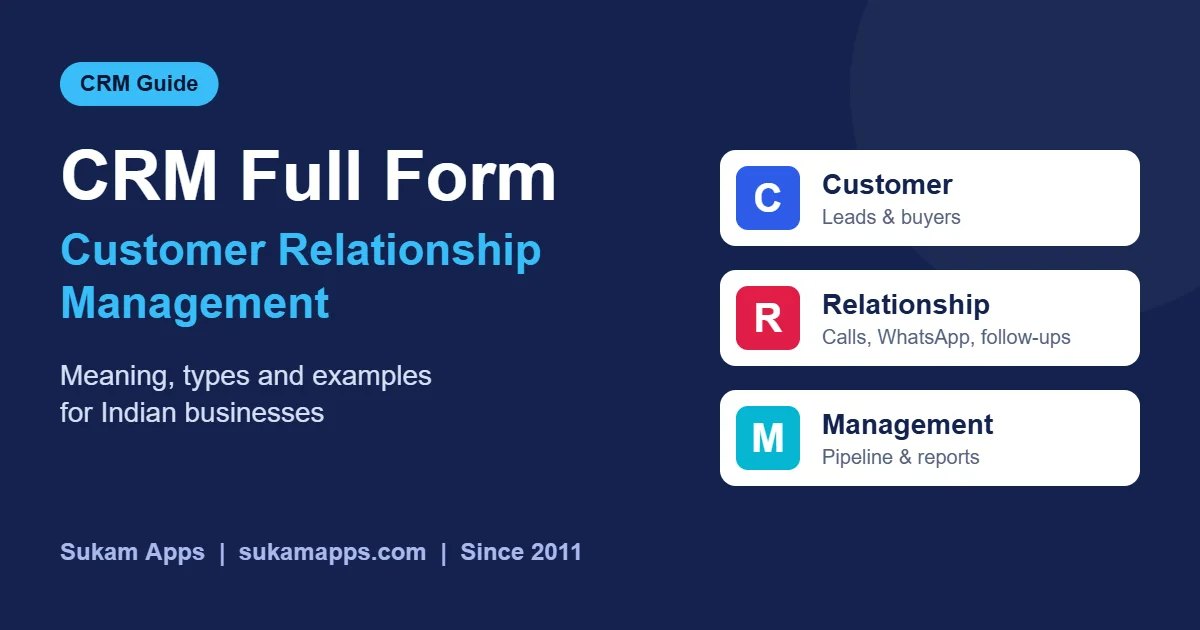
CRM full form is Customer Relationship Management. A CRM is software that keeps all your leads, customers, calls, follow-ups and quotations in one place, so your team never forgets an enquiry and the owner can see every sale in progress.
If you run a business in India, you have probably heard salespeople, software companies or your CA talk about “CRM”. This guide explains the CRM full form, what it means in simple words, the types of CRM, and how Indian small businesses use it every day, with examples from IndiaMART, TradeIndia, WhatsApp, telecalling and Tally.
CRM Full Form and Meaning
Customer Relationship Management. In simple words, CRM means taking care of every customer relationship in an organised way: who enquired, what they asked for, who in your team is talking to them, what was promised, and when to follow up next.
CRM meaning in Hindi: ग्राहक संबंध प्रबंधन (grahak sambandh prabandhan).
The word “CRM” is used in two ways:
- As a business approach: putting the customer at the centre of sales, marketing and service.
- As software: the tool that makes this possible, usually a web and mobile app your sales team uses daily.
When Indian business owners say “we need a CRM”, they almost always mean CRM software.
Types of CRM
There are three main types of CRM. Most modern CRM software for small businesses includes all three in one product.
1. Operational CRM
Handles daily work: capturing leads, assigning them to salespeople, follow-up reminders, quotations, orders and service tickets. For a small business, this is the most important part.
2. Analytical CRM
Turns your customer data into reports: which lead source brings the most orders, which salesperson converts best, how many leads are pending follow-up, and where deals are getting stuck.
3. Collaborative CRM
Shares customer information across teams and channels, so sales, service and accounts all see the same customer history, whether the customer called, sent a WhatsApp message or filled a website form.
What Does a CRM Do? Examples for Indian Businesses
Here is how a CRM works in a typical Indian small or mid-sized business:
- Captures leads automatically: enquiries from IndiaMART, TradeIndia, Justdial, your website, Facebook and Instagram ads land in the CRM without copy-pasting.
- Assigns leads to the right person: by city, product or turn, so no enquiry sits unanswered.
- WhatsApp follow-ups: send catalogues, price lists and reminders on WhatsApp from the CRM, with the chat saved against the customer.
- Telecaller calls: telecallers call leads from the CRM mobile app; every call is logged and recorded, and the next follow-up date is set before the call ends.
- Quotations: create and send a quotation in a few clicks and track whether the customer has replied.
- Tally connection: sales in the CRM and accounts in Tally stay in sync, so you do not enter the same customer twice.
- Owner dashboard: see today’s leads, pending follow-ups, quotations sent and orders won, from your phone.
Example: a machinery manufacturer in Ludhiana gets 40 enquiries a day from IndiaMART, TradeIndia and its website. Without a CRM, leads are spread across email, WhatsApp and a register, and many are never called back. With a CRM, every lead is assigned within minutes, follow-ups are reminded automatically, and the owner sees which leads turned into orders.
CRM vs Excel: What Is the Difference?
| Point | Excel sheet | CRM software |
|---|---|---|
| Lead entry | Typed by hand | Captured automatically from IndiaMART, TradeIndia, website and ads |
| Follow-up reminders | None; depends on memory | Daily follow-up list for each salesperson |
| Calls and WhatsApp | Not linked | Call logs, recordings and WhatsApp chats saved per customer |
| Team access | File copies, version confusion | One live system with user rights |
| Owner visibility | Only when someone sends the sheet | Live dashboard and reports on mobile |
| When staff leave | Customer history often goes with them | History stays with the business |
Excel is fine when you have a handful of customers. Once leads come from many sources and more than one person handles them, a CRM saves lost enquiries and the owner’s time.
How to Choose a CRM for Your Business
- Start with your sales process: write down how a lead becomes an order in your business today.
- Check lead capture: it should pull leads from the portals you use, such as IndiaMART and TradeIndia, plus your website and ads.
- Check calls and WhatsApp: most Indian sales happen on the phone and WhatsApp, so both should work inside the CRM.
- Keep it simple: fewer compulsory fields means your team will actually use it.
- Ask about integrations: Tally, telecalling app, Cloud IVR and email.
- Check support and training: who will set it up, train your staff and answer the phone when something goes wrong.
For a detailed comparison, read our guide: Best CRM Software for Small Business in India (2026).
Sukam Apps CRM: Built for Indian SMBs
Sukam Apps CRM, a CRM software in India built for SMBs, brings sales, marketing and helpdesk into one simple system, with IndiaMART and TradeIndia lead capture, WhatsApp, telecaller app, Cloud IVR and Tally integration. Sukam Apps has served Indian businesses since 2011 (15+ years). We do on-site setup and staff training in Punjab, Chandigarh, Haryana, Delhi NCR and Himachal Pradesh, and online setup for the rest of India, and every client gets a dedicated support person.
Want to see how it would work for your business? Call 99142 49191 or WhatsApp us for a free demo.
Frequently Asked Questions
What is the full form of CRM?
CRM full form is Customer Relationship Management. It means the process and the software a business uses to manage leads, customers, follow-ups and sales in one place.
What is the meaning of CRM in Hindi?
In Hindi, CRM (Customer Relationship Management) is called ग्राहक संबंध प्रबंधन. It means managing your relationship with every customer, from the first enquiry to repeat sales.
What are the 3 types of CRM?
The three main types are operational CRM (daily sales, marketing and service work), analytical CRM (reports and insights from customer data) and collaborative CRM (sharing customer information across teams and channels). Most small business CRMs combine all three.
What is CRM with an example?
A trader gets an enquiry on IndiaMART. The CRM saves it as a lead, assigns it to a salesperson, reminds them to call, records the call, sends the quotation on WhatsApp and reminds them to follow up until the order is won or lost.
Is Excel a CRM?
No. Excel can store a customer list, but it cannot capture leads automatically, remind staff about follow-ups, record calls or show the owner a live sales pipeline. Many businesses start with Excel and move to a CRM when leads grow.
Which CRM is best for small businesses in India?
The best CRM is one your team will use every day: automatic lead capture from IndiaMART and TradeIndia, WhatsApp and call integration, simple follow-ups and local support. Sukam Apps CRM is built for Indian SMBs; compare a few options before you buy.
What is the difference between CRM and ERP?
CRM manages the front office: leads, customers, follow-ups and sales. ERP manages the back office: inventory, purchase, production and accounts. Many Indian businesses use a CRM for sales and Tally or an ERP for accounts, connected to each other.